How Museums Foster Cultural Dialogue and Education
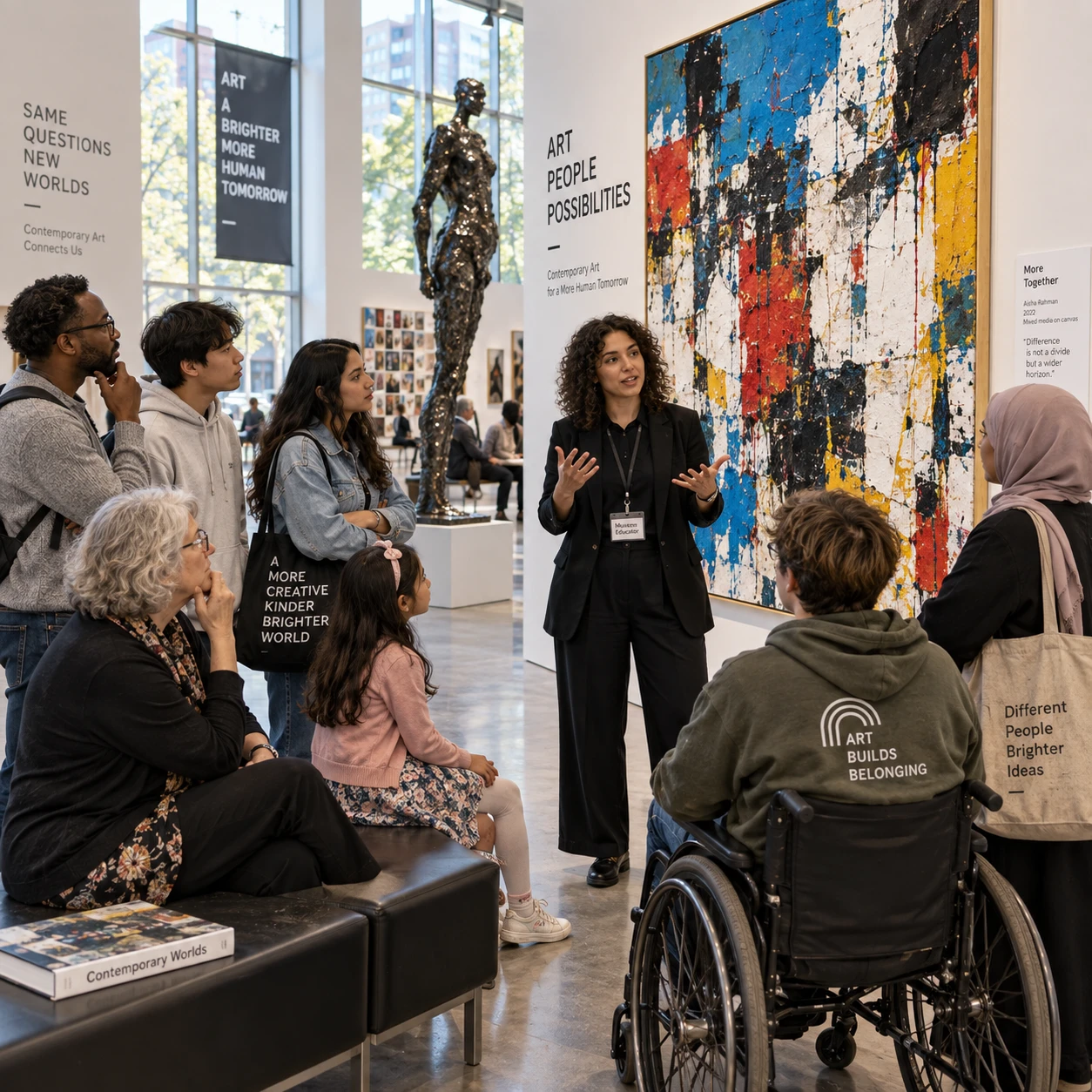
Museums can bring people into conversation with histories and viewpoints they might not encounter in daily life. Through exhibitions, museum biennales, learning programs, and community partnerships, they create opportunities to ask questions, share knowledge, and consider how cultural heritage is interpreted. That work is most meaningful when museums recognize that they are not neutral spaces: choices about what to collect, display, and explain shape the stories visitors hear.
Museums as spaces for cultural exchange
Museums foster cultural exchange by placing different histories, identities, and perspectives in conversation. They can help visitors encounter unfamiliar experiences while making room for people to interpret objects and stories through their own knowledge.
A gallery can hold many kinds of evidence: an artwork, a family photograph, an oral history, or an object connected to migration. Bringing these materials together can reveal links between communities and periods, but it can also surface disagreement about ownership, memory, or representation. Cultural dialogue does not require everyone to reach the same conclusion. It depends on visitors being able to consider evidence, hear different accounts, and ask who has the authority to tell a story.
Curatorial practice helps set the terms of that exchange. Curators make decisions about selection, placement, labels, and whose voices appear in interpretation. Museums can make those decisions more visible by explaining an object's context, acknowledging gaps in the collection, and including perspectives from people connected to the history being presented. This approach treats visitors as active participants rather than passive recipients of institutional knowledge.
Exhibitions that invite dialogue
Exhibitions invite dialogue when their themes, objects, and interpretation give visitors room to connect, question, and respond. Clear context and varied viewpoints help turn looking into a learning experience.
A strong exhibition does more than assemble visually compelling objects. It gives visitors a way to understand why the objects are together and what questions they raise. For example, an exhibition about changing neighborhoods might pair archival maps with contemporary photographs and residents’ recorded memories. The combination can help visitors compare official records with lived experience, without suggesting that one source tells the whole story.
Interpretation matters as much as selection. Labels can explain an object's origin and use, identify uncertainty, and distinguish documented facts from curatorial interpretation. Inclusive interpretation may also include first-person accounts, translations, audio, or questions that invite reflection rather than dictate a single response. These choices can make complex subject matter easier to enter, though short labels alone cannot resolve difficult histories. Museums should offer further resources and opportunities for conversation when a topic calls for more context.
Visitors can be encouraged to respond through facilitated discussions, reflection cards, or moderated digital prompts. The aim is not to collect opinions for their own sake. It is to create a thoughtful exchange grounded in the exhibition's evidence and the knowledge people bring with them.
The role of biennales in presenting diverse perspectives
Museum biennales bring artists, ideas, and audiences into contact across cultural and geographic boundaries. They can introduce new artistic voices and create timely spaces for exchange, provided the event offers context beyond a quick display of difference.
Biennales often gather work from multiple regions around a shared theme or curatorial question. That format can make connections visible across different artistic practices, while helping audiences encounter artists who receive less attention in established collections. A thoughtful biennale explains why works are in conversation and gives visitors enough information to understand their distinct contexts.
Cross-cultural presentation carries responsibilities. If an artwork is reduced to a label such as “traditional” or “global,” the exhibition may flatten the artist's practice instead of expanding understanding. Curators can avoid that by working with artists on how their work is presented, providing accurate translations, and making room for specific historical and political context. Dialogue works both ways: visitors learn about the work, and the institution may need to reconsider its own assumptions about art, expertise, and cultural authority.
Biennales also have practical limits. A temporary event can attract attention, but its impact depends on what happens before and after the exhibition: accessible interpretation, public programs, fair relationships with contributors, and documentation that remains useful when the event closes.
Learning beyond the gallery
Museum education extends learning beyond the gallery through guided visits, workshops, talks, and resources designed for different ages and needs. These formats help visitors connect exhibits to questions they can explore together.
A school visit might begin with close looking: students describe details in an object before learning its history. A facilitator can then invite them to compare interpretations, ask what evidence supports each idea, and connect the work to a classroom topic. For adults, a curator-led tour or artist talk can reveal how an exhibition was developed and where its interpretation remains open to discussion.
Workshops offer another route. Participants might respond to an exhibition through writing, making, or recording an oral history. The activity should support learning rather than imply that a brief exercise can stand in for the communities or histories represented. Museums can also provide educator guides, captioned videos, audio descriptions, translated materials, and online collection resources so learning is not limited to a scheduled visit.
Good museum education adapts to its audience without assuming everyone starts from the same knowledge or has the same access needs. Programs work better when educators can adjust pace, language, and activities, and when visitors can choose how to participate. A workshop may be lively and hands-on; a quiet, self-guided visit can be just as valuable.
Working with communities
Museums work with communities by involving people in decisions about interpretation, programming, and the use of cultural knowledge. Sustained collaboration can bring local experience into the museum while making institutional responsibilities more accountable.
Community engagement is more than asking for feedback after an exhibition is finished. Museums can invite community members to help shape the subject, identify relevant objects and stories, review labels, lead programs, or advise on how sensitive material should be presented. These roles should be clearly defined, and contributors should understand how their knowledge will be used. When substantial labor is requested, fair compensation and appropriate credit matter.
Partnerships can also reveal what a collection leaves out. A local group may identify a place name, tradition, or historical event that institutional records have overlooked. Oral histories and community archives can add detail, but they require careful consent, storage, and access decisions. Some knowledge may be private or restricted; a museum should not assume that public display is always the right outcome.
To keep collaboration genuine, museums can report back on what changed because of community input. That might mean revising an interpretation, adding a program, or explaining why a requested change was not possible. Trust develops through follow-through, not consultation alone.
Building inclusive, ongoing conversations
Museums build inclusive, ongoing conversations by improving access, presenting more than one interpretation, and giving visitors ways to stay involved. Inclusion is an ongoing practice, not a one-time exhibition feature.
Accessibility includes the physical visit and the content itself. Step-free routes, seating, clear wayfinding, large-print text, captions, audio description, and sensory information can help more people take part. Plain-language labels and translations can reduce barriers, while digital resources can help visitors prepare before arriving. No single format serves everyone, so museums benefit from testing materials with the people expected to use them.
Multiple interpretations also require care. A museum can acknowledge disagreement without treating every claim as equally supported by evidence. Labels and programs should distinguish fact, contested interpretation, and personal testimony. Facilitators need guidance for handling difficult conversations, including how to make space for disagreement without allowing harassment or putting the burden of explanation on visitors from affected communities.
To sustain engagement, museums can offer follow-up discussions, repeat workshops, community advisory groups, and ways to respond after a visit. They can then review who is participating and what barriers remain, rather than relying only on attendance totals. Cultural dialogue takes time. A museum earns the chance to continue it by listening carefully, explaining its choices, and changing course when its approach falls short.