Preserving and Showcasing Bihar’s Heritage Through Museums
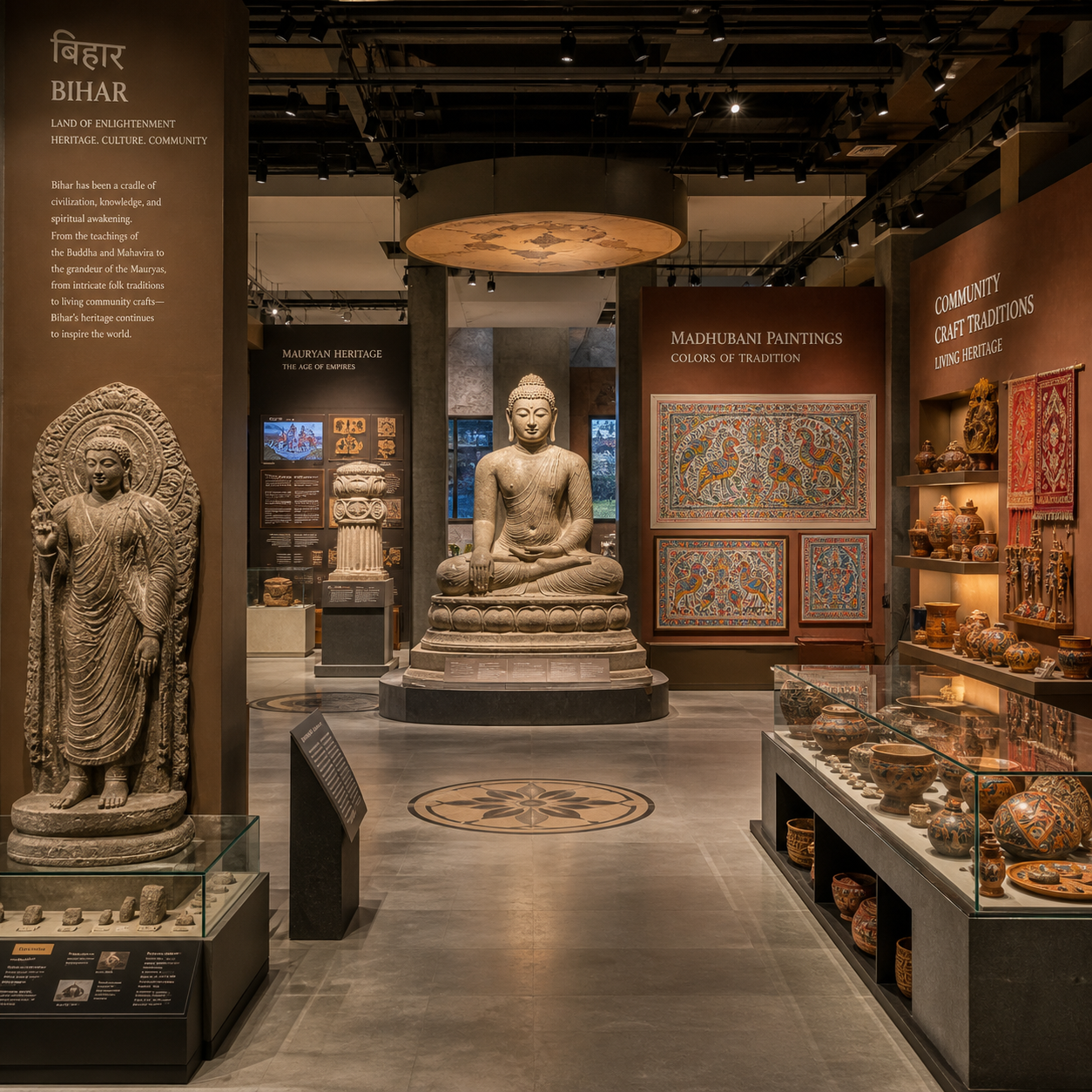
Bihar’s cultural heritage reaches across ancient universities, Buddhist pilgrimage sites, Mauryan architecture, vernacular art, religious traditions, craft practices, languages, and everyday knowledge. Museums can bring these strands together, protecting fragile evidence of the past while helping people understand how heritage continues to shape life in the present.
Why Bihar’s Heritage Matters
Bihar’s cultural heritage matters because it connects archaeological history, artistic expression, religious memory, and living community traditions across generations. Preserving it gives communities a stronger relationship with place and enables visitors to encounter Bihar through more than isolated monuments or famous objects.
The state’s historical importance includes the Mauryan and Buddhist heritage associated with places such as Pataliputra, Bodh Gaya, Rajgir, Nalanda, and Vaishali. Nalanda and Vikramashila heritage also reflects Bihar’s role in the intellectual networks of the Buddhist world, where teachers, students, manuscripts, and ideas travelled across Asia.
Yet Bihar’s heritage is not confined to excavated sculpture or architectural fragments. Madhubani painting, folk performance, weaving, metalwork, ritual practices, seasonal festivals, oral histories, and regional foodways represent forms of intangible cultural heritage. They change over time because communities adapt them to new materials, audiences, economies, and social conditions.
That variety creates a preservation challenge. A stone object can be stabilised in a controlled environment, while a song, technique, or festival depends on people who practise and transmit it. Effective museums therefore need both conservation expertise and relationships with knowledge holders.
Museums as Custodians of Bihar’s Past
Museums in Bihar preserve heritage by caring for objects, recording their histories, and providing the conditions in which people can study and understand them. Their work includes conservation, documentation, storage, research, exhibition planning, education, and responsible access.
Institutions such as Patna Museum and Bihar Museum can help audiences encounter archaeological finds, sculptures, coins, manuscripts, paintings, textiles, and historical documents within a wider narrative. The object itself is only one part of that narrative. Its material, date, place of discovery, maker, use, ownership history, and relationship to other objects all influence how it should be interpreted.
Good collections care begins with practical systems: stable temperature and humidity where appropriate, protection from light, pest monitoring, secure storage, condition reporting, and careful handling. Digital records support this work by tracking provenance, conservation treatments, locations, and research updates. They do not replace physical conservation, but they reduce unnecessary handling and make scholarship more efficient.
Ethical collecting is equally important. Museums should document provenance, follow applicable laws, avoid acquiring objects of uncertain origin, and consult relevant communities when collections involve sacred, funerary, or culturally sensitive material. Choosing broader access for the benefit of research may sometimes conflict with restrictions requested by a community. Such decisions require transparent policies rather than a single rule applied to every object.
Information about Bihar’s ancient sites can also be connected to wider public resources, including the Archaeological Survey of India, which documents and protects many important monuments and archaeological locations.
Telling Bihar’s Stories Through Curated Exhibitions
Curated exhibitions make Bihar’s heritage meaningful by linking objects to people, places, ideas, and present-day questions. A strong exhibition gives visitors a clear route through complex history without reducing it to a timeline of dates and rulers.
One useful approach is thematic interpretation. A gallery might explore learning and travel through Nalanda and Vikramashila, the spread of Buddhist thought, riverine settlement, or the changing visual language of Madhubani painting. Themes encourage connections between objects that may come from different periods while preserving historical distinctions.
Labels should answer the questions visitors naturally ask: What is this? When and where was it made? How was it used? Why does it matter? Plain English can sit alongside Hindi and, where relevant, other local languages. Multilingual interpretation is not a decorative addition; it expands who can participate in the museum.
Exhibition designers can combine maps, timelines, replicas, touchable materials, photographs, sound, and short first-person accounts. A carved fragment becomes more understandable when visitors can see its original architectural setting. A painting becomes more layered when the display explains technique, patronage, gendered labour, markets, and the choices made by contemporary artists.
Accessibility should be planned from the start. Clear typography, seating, tactile elements, captioned films, audio description, ramps, and quiet viewing areas help people with different physical and sensory needs. Immersive design can create attention, but spectacle should never overpower evidence or encourage visitors to mistake reconstruction for original history.
Representing Living Traditions and Local Communities
Museums represent living heritage responsibly when practitioners and communities help shape what is collected, displayed, and said about their traditions. Participation turns heritage interpretation from observation into dialogue.
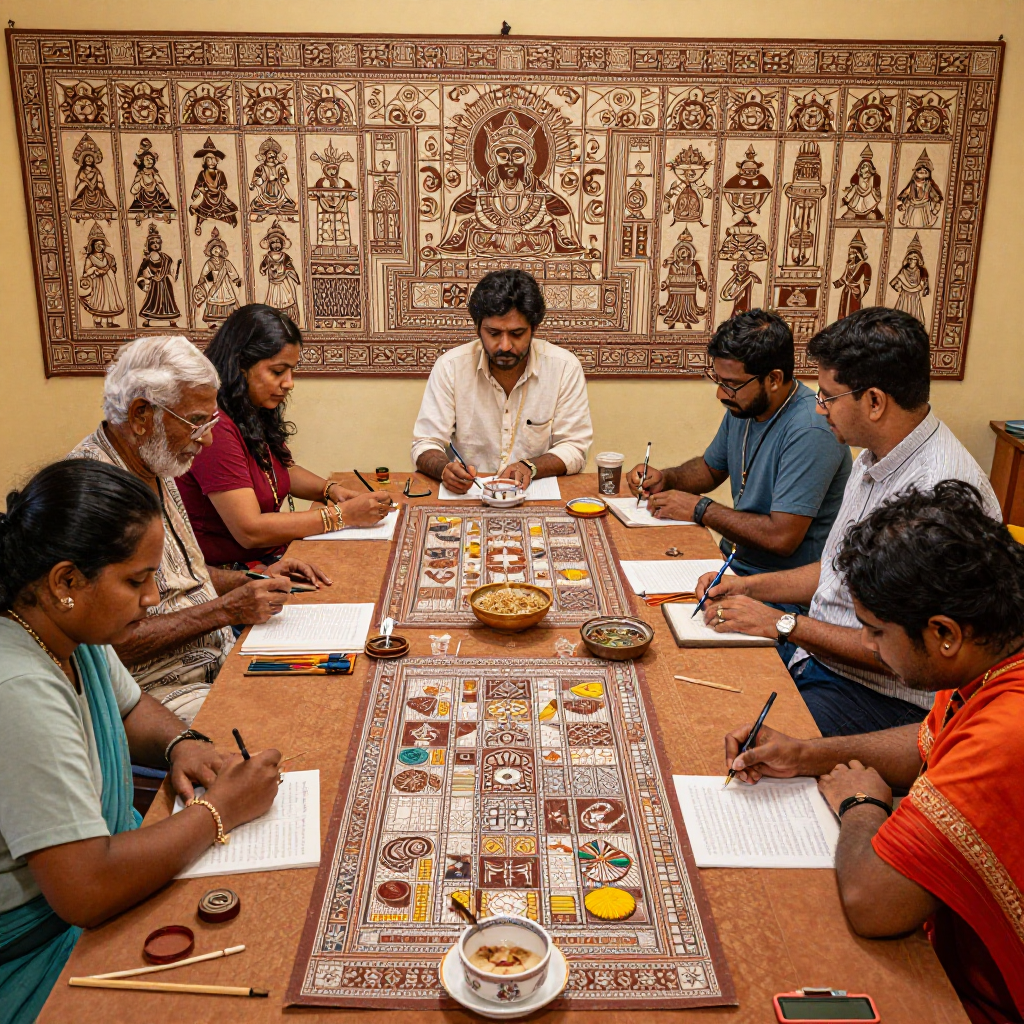
Community-led conservation may involve recording oral histories, inviting artists to demonstrate techniques, commissioning new work, documenting local vocabulary, or creating advisory groups for exhibitions. Craftspeople, performers, monks, scholars, farmers, storytellers, and family archivists may hold knowledge that is absent from written records.
These contributions need meaningful recognition. Museums can pay contributors, credit their expertise, share recordings, and explain how their material will be stored and used. A community should not be asked to provide knowledge for free while the institution presents that knowledge as its own authority.
Living traditions also require careful language. Madhubani painting should not be presented as a single, frozen style, because artists work across regional, familial, religious, and commercial contexts. Likewise, festivals and religious practices should be interpreted with attention to internal diversity rather than treated as uniform performances for visitors.
A practical model is the three-part story: institutional evidence, community knowledge, and contemporary response. An ancient sculpture might be interpreted through archaeological research, a local account of its cultural meaning, and a new artwork responding to its themes. This structure gives historical continuity room to coexist with present creativity.
Using Technology to Expand Access and Engagement
Technology expands access to Bihar’s museums through digital catalogues, virtual exhibitions, audio-visual interpretation, and online learning resources. These tools help people explore collections remotely and support visitors before, during, and after a physical visit.
A searchable digital catalogue can provide object images, collection numbers, descriptions, conservation notes, and related sites. Virtual exhibitions can connect the history of Nalanda and Vikramashila with maps showing regional and international networks. Short videos may document a craft process or an artist’s explanation in their own voice.
Interactive displays work best when they answer a genuine interpretive need. A layered map can show how a settlement changed; a digital reconstruction can explain the original position of an architectural fragment; an audio station can present several languages or conflicting memories of a place. Technology should clarify relationships, not simply add movement to a gallery.
There are limits. Digital access depends on electricity, connectivity, language skills, device availability, and maintenance budgets. A virtual tour cannot reproduce the scale, material presence, or social experience of standing before an original object. Museums should therefore treat technology as a complement to collections and expertise.
Every digital project also needs consent, copyright controls, backup systems, metadata standards, and a plan for updates. Community recordings may require restricted access, while sacred images may not be suitable for unrestricted publication. Responsible digitisation preserves access without assuming that everything should be made universally downloadable.
The Role of a Museum Biennale in Bihar’s Cultural Exchange
A museum biennale can connect Bihar’s museums, artists, researchers, educators, and communities through exhibitions, debate, experimentation, and cultural exchange. Its value lies in creating sustained collaboration rather than staging a single celebratory event.
A Bihar-focused museum biennale could invite institutions to compare approaches to Buddhist heritage, Mauryan history, local archives, contemporary art, and intangible cultural heritage. It might pair a museum in Patna with a district museum, university department, community archive, or craft collective. Such partnerships can reveal different ways of deciding what deserves preservation and who has the right to interpret it.
Biennale programming could include:
- co-curated exhibitions on Nalanda, Vikramashila, and Buddhist knowledge networks;
- conservation demonstrations and collection-care training;
- artist residencies responding to museum objects and local landscapes;
- public conversations in Hindi, English, and regional languages;
- school programmes, walking seminars, oral-history labs, and community archives;
- digital showcases connecting Bihar with museums across South Asia.
The format also encourages institutions to test new ideas. A small museum may contribute a focused story rather than compete with a large collection. The trade-off is that experimentation needs evaluation: organisers should record participation, accessibility, community feedback, and the long-term use of documentation instead of judging success only by attendance.
Building a Sustainable Future for Heritage Preservation
A sustainable future for Bihar’s heritage depends on long-term conservation plans, trained professionals, ethical partnerships, inclusive access, and continued public engagement. A successful exhibition matters, but preservation requires systems that remain active after the gallery closes.
Museums can begin with a practical priority framework:
- Document: create accurate records, photographs, provenance notes, oral histories, and condition reports.
- Protect: address storage, environmental risks, disaster preparedness, security, and conservation treatment.
- Interpret: develop historically sound, multilingual, accessible narratives with community input.
- Share: provide exhibitions, education, digital resources, research access, and public programmes.
- Review: gather feedback and revise displays as scholarship and community priorities develop.
Skills development should include conservators, registrars, educators, designers, translators, digital specialists, and community researchers. Partnerships with universities can support material analysis and historical research, while local training programmes can strengthen employment pathways for young people.
Common mistakes deserve attention. Treating heritage as only ancient objects excludes living practitioners. Using untranslated labels narrows the audience. Digitising collections without metadata creates attractive but unreliable information. Inviting communities only after exhibition decisions are complete produces consultation without shared authority.
Bihar’s museums can avoid these problems by treating preservation and access as connected responsibilities. When Patna Museum, Bihar Museum, local institutions, knowledge holders, and a museum biennale work through that shared purpose, heritage becomes available for study, reflection, and renewed cultural expression.
Frequently Asked Questions
How do museums help preserve Bihar’s cultural heritage?
Museums preserve Bihar’s cultural heritage through collection care, documentation, conservation, research, exhibitions, education, and responsible digital access. They protect material evidence while recording the knowledge and practices associated with it.
What types of heritage should museums in Bihar showcase?
Museums in Bihar should present archaeological and architectural heritage alongside Madhubani painting, crafts, manuscripts, oral traditions, languages, festivals, religious practices, performance, and contemporary community creativity.
How can local communities participate in museum programmes?
Communities can participate as advisers, contributors, artists, researchers, performers, storytellers, and co-curators. Meaningful participation includes payment, credit, consent, shared decision-making, and access to the resulting records.
How can technology make Bihar’s museums more accessible?
Digital catalogues, virtual exhibitions, multilingual audio, captioned films, interactive maps, and online learning resources can reach people who cannot visit in person. These tools should complement physical collections and professional conservation.
What role can a museum biennale play in promoting Bihar’s heritage?
A museum biennale can support collaboration among museums, artists, researchers, educators, and communities. It can increase visibility while encouraging new forms of interpretation, conservation training, cultural dialogue, and public participation.